
Sensex to hit record high in 2015, but analysts cut forecast

With RBI holding on to rates, investors should avoid longer duration funds for the near future, experts tell Joydeep Ghosh

Slight recovery in growth is expected only in July-September.

If the industrial sector expanded, growth rate is likely to rise in the remaining quarters to reach 7.6-7.8 per cent for 2017-18.

Though it is likely gross domestic capital formation increased in the quarter ended June, against declines in the previous two quarters, a significant revival in investment might take a few quarters more, economists say.

The finance minister may stagger some of the recommendations.

With the gradual opening up of shops, hotels, restaurants and catering services with limited number of participants, milk consumption has improved by 5-10 per cent from the lowest level.

Till June 30, the southwest monsoon was 33 per cent lower than normal, which is among the worst in the last five years, with 28 of the 36 meteorological divisions recording deficient rain.

Power generation and distribution is the most indebted sector

With fuel being the main input cost for the transport sector, rise in cost of operations is a given. The sector is unsure on the extent of being able to pass this on through rentals or to absorb it with higher volumes.

Saudi Arabia is insisting on 'In Kingdom' total value-addition requirements

A monsoon deficit is likely to affect the agriculture output, which could have an impact on the food inflation

Ways on how consumers can maximise benefits.

Even if RBI partially replaces the stock of the high value notes, RBI will have to incur thousands of crores of rupees in cost, say economists.

Experts say a large part of the expenditure in April was spent on heads such as creating infrastructure for testing capacity and procuring testing kits, among other things.

Since March 2020, WPI food inflation rate continued to fall but the CPI-food inflation rose, signaling a breakdown in supply chain from the mandis to the final household.

The government clarified that the majority of industrial establishments had reported nil production, and cautioned that the numbers should not be compared with those of previous months. "It is not appropriate to compare the IIP of April 2020 with that of earlier months, and users may like to observe the changes in the IIP in the following months," said the ministry of statistics & programme implementation.

While the positive surprise has been the high growth in agriculture, the negative surprise is in the trade, transport, hotels segment where growth came lower than expected, says Madan Sabnavis.

The highest number of jobs were created in the age group of 18-21 at 1.29 million, followed by 22-25 years of age at 1.12 million during these seven months.

After the government sought Parliament's nod for a second batch of supplementary demand for grants that will cause a hit of Rs 2.99 trillion to the exchequer, doubts suddenly arose about the government's ability to meet the Budget projections of reining in its fiscal deficit at 6.8 per cent of gross domestic product (GDP), or Rs 15.06 trillion, for the current financial year. Till now, many were of the opinion that the government would succeed in checking the deficit at a much lower figure than what was given in the Budget Estimates (BE). The government had sought Parliament's approval to spend Rs 3.74 trillion extra, but Rs 74,517.01 crore will be matched by equal savings on other heads.

This time there has been a rather peculiar criticism of the latest GDP numbers.
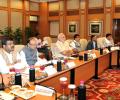
The meeting will focus on how to make the crisis an opportunity for India.

'If you see the composition of items which are causing this spike in prices, most of them have little to do with the kharif harvest, except for pulses and vegetables to some extent.' 'I don't know on what basis the government is claiming that food prices will moderate in the weeks to come.'

The government had breached its fiscal deficit target given in the Budget for 2017-18 in November itself, touching 112 per cent of the limit.

If imputed inflation for April and May is used, then you have inflation of over 6 per cent for two consecutive quarters, which is a worrying signal for the RBI.

If the government cuts wasteful expenditure as it is trying now, the deficit would at most fall to 8 per cent, not less than that.

CRISIL chief economist D K Joshi is of the opinion that GDP is an indicator of the health of the economy.

Cabinet note being readied, on basis of study, to ensure against foodgrain shortage; might require buffer of up to 50% more.

The bigger worry is that its effects could linger well into the next financial year.

Prime Minister's Economic Advisory Council (PMEAC) Chairman C Rangarajan may have found the Reserve Bank of India (RBI)'s inflation projections on the higher side, but independent experts agree with the central bank and expect both wholesale and retail prices to remain high.

While the farmers are not getting remunerative prices for their produce, at the same time they are forced to pay high prices for items they consume.

Experts said the slowdown could be attributed to adjustments leading to destocking and the offering of discounts by companies as the government ushered in the new indirect taxation system on July 1.

The main reason was that CPI inflation would likely remain below 4 per cent till July.

Amid hints that the government might be exploring capping royalty payments by India-based subsidiaries to US companies, experts warn Subhayan Chakraborty why such a move will only hurt the Indian economy.

An analyst says, due to excess capacity, investment in manufacturing will not be forthcoming

Unless supported by investment, any spark of a recovery could be temporary, hint economists.

Though inflation, on the basis of the wholesale price index, is nowhere near the 1990-91 level of 10.26 per cent and India is in a much better position to check it, the greater integration of our economy with the globe has exposed it to a much higher risk of imported inflation.

The reason why private banks will play the deposit pricing game strategically is the weakening of banks' deposits base given the competition from MFs and insurance companies due to tax-savings schemes.
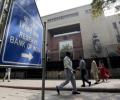
According to Soumya Kanti Ghosh, chief economic advisor of the State Bank of India group, a 50 bps rate cut is a possibility, but 25 bps is more likely.

The Consumer Price Index hit the lowest in six months in March at 4.83 per cent.
